Most home media stacks do not fail because one app is bad. They fail because the workflow is accidental. A torrent client is added here, an IPTV playlist there, a NAS later, a VPN after something feels risky, and a dozen settings become tribal knowledge.
That is why applied industrial technologies is a useful lens for cord cutters, torrent users, IPTV viewers, and media tech hobbyists in 2026. Not because your living room is a factory. Because reliable systems use the same habits: defined inputs, observable state, repeatable processes, safe boundaries, and clear ownership.
Teams think the problem is finding the perfect streaming app. The real problem is building a media workflow that stays legal, private, stable, and supportable when sources change, playlists drift, storage fills, and networks misbehave.
The practical question is not whether you can play a file or tune a channel once. The practical question is whether the whole pipeline still works next month without guessing.
Table of contents
- Applied industrial technologies is a workflow problem
- Map the media pipeline before buying tools
- Build legal and safe acquisition workflows
- Treat IPTV like a reliability system
- Design storage compute and network boundaries
- Automate monitoring without creating noise
- Manage privacy security and compliance
- Implement applied industrial technologies in phases
- Compare consumer media setups with industrialized workflows
- Where bittorrented.com fits
- Closing checklist for 2026
Applied industrial technologies is a workflow problem
Why media stacks now look industrial
A modern cord-cutting setup has more moving parts than many small office IT systems had a decade ago. You may have IPTV playlists, legal public-domain torrent discovery, private media backups, Jellyfin or Plex, transcoding hardware, DNS filtering, VPN policies, subtitle tools, metadata agents, and family devices with different capabilities.
That changes the conversation. The mistake teams make is treating each piece as a separate hobby project. They debug the player, then the router, then the NAS, then the playlist, but never draw the path from source to screen.
Applied industrial technologies means taking ideas from operations, automation, asset management, and process control and applying them to practical systems. In a media context, that means asking boring but valuable questions:
- Where does content enter the system?
- How do you know it is legal to use and safe to open?
- Where is metadata generated and corrected?
- What service owns playback state?
- What happens when storage is full?
- What happens when a provider, feed, or index changes?
- Who gets alerted, and what should they do?
None of this requires enterprise software. It requires a different operating model.
The operator mindset for home media
The operator mindset is simple: assume something will drift. Playlists drift. Torrent availability changes. EPG data gets stale. Disks fill. VPN routes fail. Certificates expire. Mobile apps update and break codecs.
A useful way to think about it is to separate the system into three planes:
- Control plane: policies, automation rules, routing, scheduling, access decisions.
- Data plane: media files, streams, manifests, subtitles, metadata, thumbnails.
- Observation plane: logs, health checks, alerts, dashboards, manual review queues.
Most home setups only build the data plane. They collect files and streams. Then when something breaks, there is no control plane to enforce rules and no observation plane to explain what happened.
Practical rule: If you cannot tell whether a failure is source, network, storage, metadata, or playback within five minutes, you do not have a media system. You have a pile of apps.
Related reading from our network: teams working on crawl paths face a similar discovery-versus-control problem, and this piece on ant colony optimization algorithms for crawl paths is a useful adjacent model for thinking about signals that reinforce better routes over time.
Map the media pipeline before buying tools
Inputs metadata playback
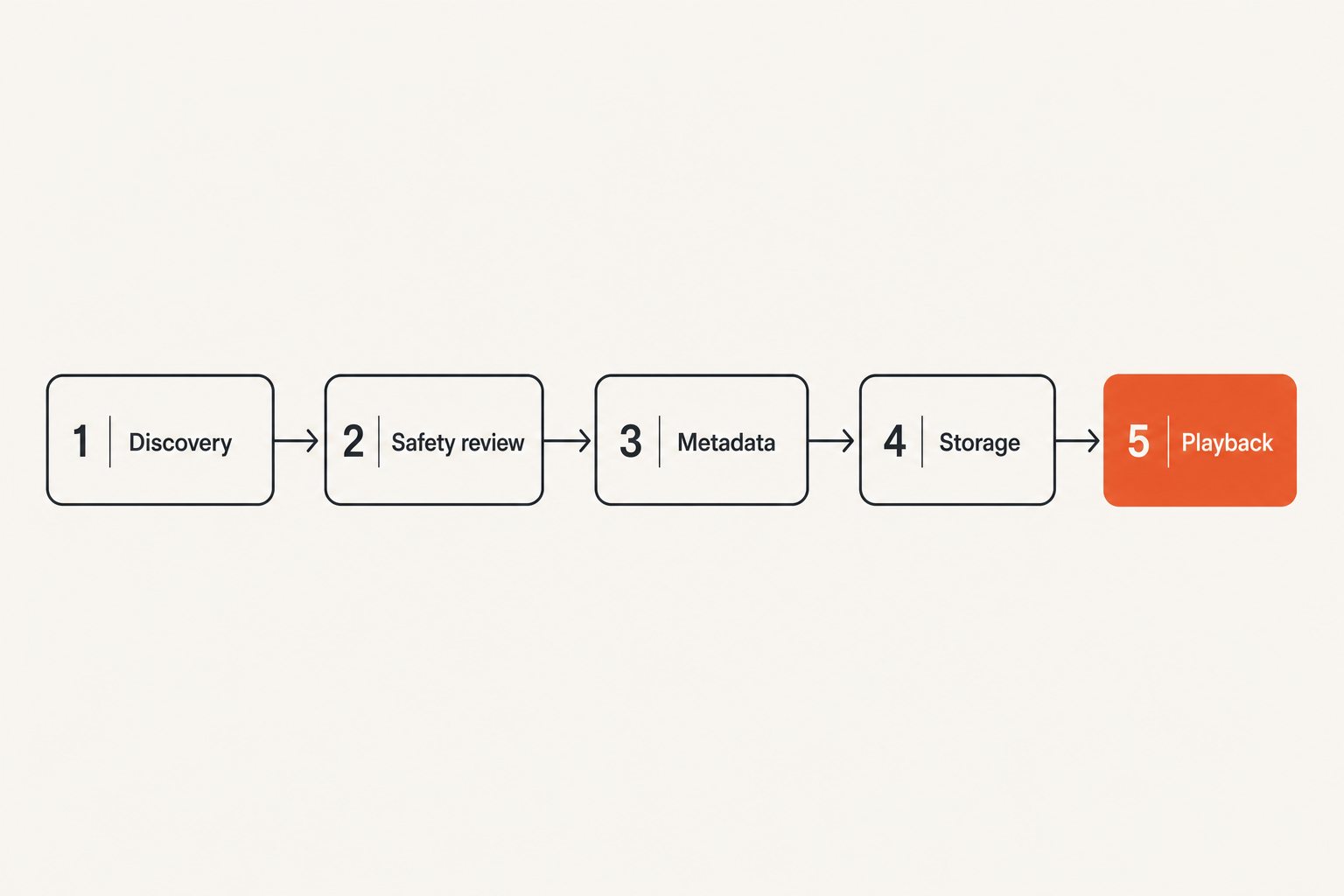
Before adding another downloader, IPTV app, or transcoder, map the pipeline. The point is not to make a fancy diagram. The point is to expose ownership.
A practical media pipeline usually looks like this:
- Source discovery: search, RSS, legal torrent catalogs, official broadcaster feeds, paid streaming services, IPTV playlists you are authorized to use.
- Safety gate: legal review, file-type restrictions, malware scanning where relevant, VPN or network policy checks.
- Acquisition or connection: download, stream, import, subscribe, or mount.
- Metadata enrichment: title matching, posters, EPG, subtitles, language, year, channel grouping.
- Storage or cache: local disk, NAS, object storage, temporary cache, time-shift buffer.
- Playback and access: TV app, browser, mobile app, casting device, remote access.
- Monitoring and cleanup: health checks, stale item removal, duplicate detection, quota management.
What breaks in practice is that people skip steps two, four, and seven. They can get media into the system, but they cannot prove it is safe, name it consistently, or maintain it.
For IPTV, this mapping matters even more. A playlist is not a service by itself. It is a pointer list that depends on upstream availability, EPG matching, network path quality, and client behavior. If you use browser-based playback or playlist testing, a dedicated page such as BitTorrented live TV can help you reason about playlist behavior without pretending that the playlist alone is the architecture.
State matters more than screens
Consumer media tools sell screens: grids, posters, guide views, search boxes. Operators care about state.
State includes:
- Has this source been verified?
- Was this item already imported?
- Did the file finish downloading cleanly?
- Which subtitle track was selected?
- Which channel URL failed last night?
- Which user or device caused a transcode spike?
- Which rule deleted a file?
The mistake teams make is assuming the UI remembers enough. It rarely does. A player may show that a channel is offline, but it may not tell you whether the EPG failed, the DNS lookup failed, the server returned 403, or the client codec failed.
Industrial workflows preserve state because state is what lets you automate safely. Without state, automation becomes guesswork.
Build legal and safe acquisition workflows
Separate licensed sources from public discovery
Torrent and IPTV topics need careful framing. The technology is neutral. The workflow is where users create risk or reduce it. A legal Linux ISO torrent, a public-domain film, a broadcaster-provided stream, and an unauthorized redistribution link may use similar transport patterns, but they are not operationally equivalent.
Your acquisition workflow should separate source types:
- Licensed subscriptions and official apps.
- Personal backups and owned media.
- Public-domain or Creative Commons media.
- Open-source software distributions.
- Authorized IPTV playlists from a provider or organization.
- Unknown public links that require manual review before use.
Do not mix these into one blind automation path. If a tool watches everything and auto-imports everything, you have removed the safety gate.
Practical rule: Automation should be faster than manual work, not less accountable than manual work.
For public torrent visibility, discovery should stay separate from trust. Browsing DHT activity can be useful for understanding availability patterns, but it is not a license check. Treat a discovery surface like BitTorrented DHT browsing as an input to evaluation, not an approval system.
What works and what fails
What works:
- Maintain allowlists for known legal sources.
- Keep manual review for ambiguous content.
- Use separate folders or libraries by rights category.
- Reject executable files in media workflows unless there is a clear reason.
- Prefer official feeds and publisher-provided torrents where available.
- Document provider terms for IPTV playlists.
What fails:
- Auto-importing from unknown indexes into a family media server.
- Treating magnet availability as proof of legitimacy.
- Mixing personal backups with unverified public downloads.
- Running every tool through the same privileged container.
- Letting one compromised plugin write across your entire library.
The practical question is not whether a user can find something. The practical question is whether the system has a defensible path for deciding what enters the library and what does not.
Related reading from our network: high-risk payment operators face a similar trust-boundary problem, and this article on crypto checkout architecture for high-risk merchants is a useful parallel for thinking about webhooks, reconciliation, and settlement boundaries as workflow controls.
Treat IPTV like a reliability system
Playlist health EPG and channel drift
IPTV feels simple until you operate it for more than a week. Then channels move, names change, EPG IDs mismatch, logos disappear, categories duplicate, and some URLs work only from certain networks or devices.
The operator approach is to treat IPTV as a reliability system with health checks:
- Playlist fetch success.
- Channel count changes.
- Duplicate channel names.
- EPG match rate.
- HTTP status by channel.
- Startup time by channel group.
- Buffer underruns during playback.
- Geo or provider restriction errors.
You do not need to monitor every channel every minute. You do need enough scheduled testing to detect drift before the one channel you care about fails during a live event.
A clean IPTV workflow also separates raw provider data from your curated view. Store the original playlist. Generate a normalized playlist. Then generate device-specific outputs if needed. That gives you rollback.
Buffering is usually an architecture signal
Many users treat buffering as a player problem. Sometimes it is. More often it is an architecture signal.
Buffering can come from:
- Weak Wi-Fi between client and router.
- DNS resolution delays.
- VPN path congestion.
- Provider throttling or server instability.
- Too-small client buffer.
- Transcoding overload.
- Incompatible codec causing software decode.
- Multiple users saturating upstream bandwidth.
The mistake teams make is changing five settings at once. That destroys evidence. Instead, isolate the path: same channel, same time, wired client, VPN off or known route, local player logs visible, CPU and network monitored.
Practical rule: When debugging playback, change one layer at a time: source, network, server, client. If you change all four, you did not troubleshoot. You gambled.
Design storage compute and network boundaries
Hot warm cold media tiers
Storage problems are workflow problems disguised as disk problems. A large drive delays the problem. It does not solve classification.
Use tiers:
- Hot: currently watched items, active downloads, DVR buffers, transcoding cache.
- Warm: regular library content, family favorites, recent shows, frequently accessed music.
- Cold: archives, personal backups, rare media, offline drives, slower storage.
Each tier needs different rules. Hot storage should be fast and easy to clean. Warm storage should be reliable and indexed. Cold storage should be boring, backed up, and rarely touched.
Common home media failure: using one giant folder for everything. Downloads, completed files, metadata, subtitles, thumbnails, logs, and backups all land together. Then cleanup scripts become dangerous because no one knows what is safe to delete.
A better pattern:
/media
  /incoming-reviewed
  /library-movies
  /library-tv
  /library-music
  /iptv-cache
  /transcode-temp
  /archive-personal
  /quarantine
The names matter less than the separation.
Containers VPNs and split tunneling
Containers are useful because they create boundaries. They are not magic. A badly configured container with host networking, broad mounts, and privileged mode is just a messy app wearing a container badge.
For media workflows, define which services need which network path:
- IPTV player or proxy: provider-dependent, sometimes direct path performs better.
- Legal torrent client: VPN policy may be appropriate depending on jurisdiction and use case.
- Metadata agents: usually need normal web access.
- Media server: should not always sit behind a VPN if remote playback depends on stable routing.
- Admin dashboards: should not be exposed publicly without strong authentication.
Split tunneling is where many setups break. If you route everything through a VPN, metadata and remote access can fail. If you route nothing through it, privacy expectations may be wrong. The correct design is policy-based routing by service, not vibes.
Automate monitoring without creating noise
Signals worth collecting
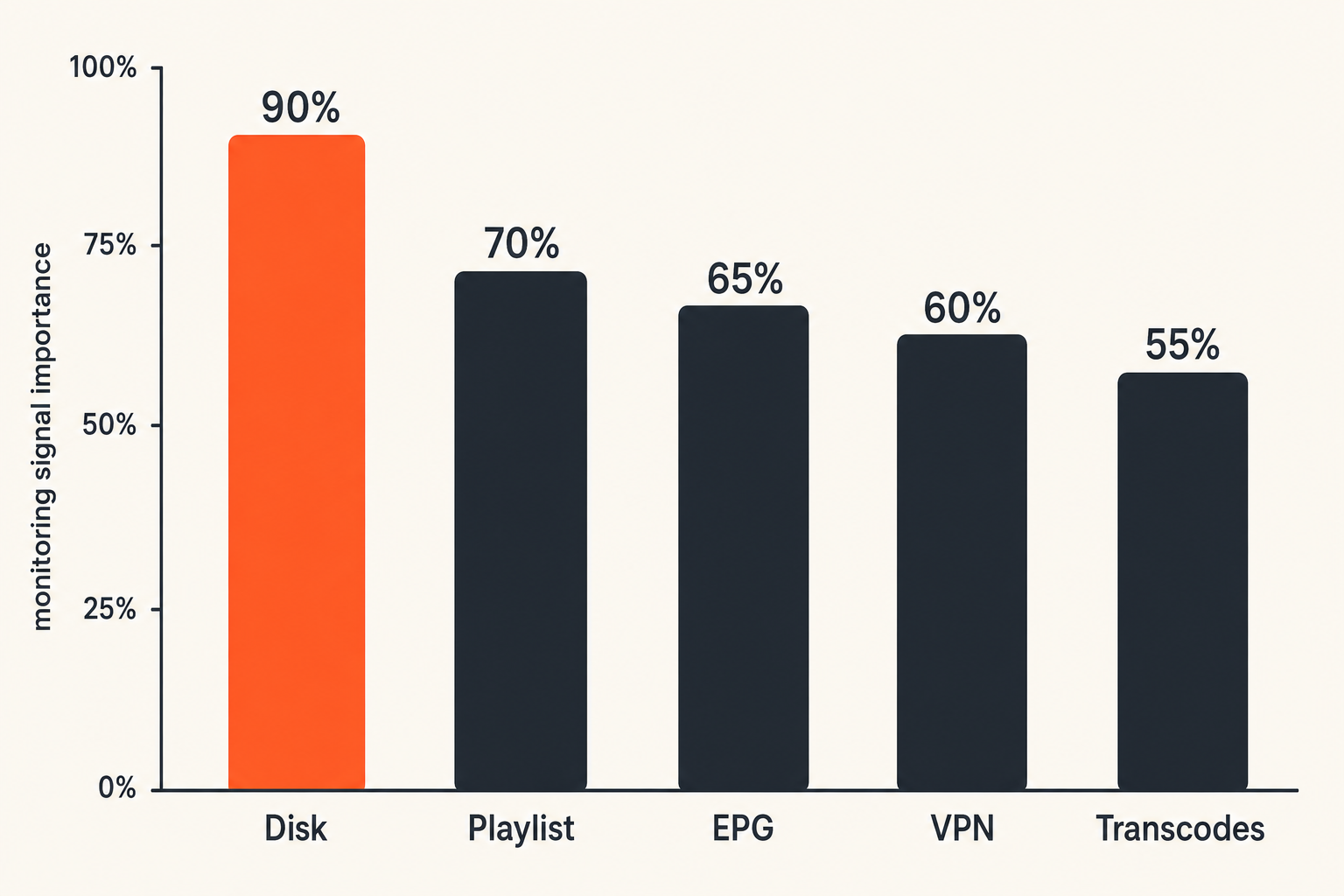
Monitoring is not about dashboards for their own sake. It is about shortening investigation time.
Useful signals for a home media system include:
- Disk free percentage by volume.
- Download queue age.
- Failed import count.
- IPTV playlist fetch status.
- EPG freshness.
- Transcode sessions and CPU or GPU load.
- Container restart count.
- VPN tunnel status for services that require it.
- DNS failures.
- Playback errors by client type.
A simple Prometheus, Grafana, Uptime Kuma, or even scheduled script setup can be enough. The point is to collect signals that map to decisions.
Bad metric: total number of media files.
Better metric: number of files in incoming-reviewed older than 24 hours.
Bad metric: server CPU.
Better metric: transcode sessions causing CPU over 85 percent for more than 10 minutes.
Alert rules that lead to action
Noise is the enemy. Many teams start monitoring and immediately alert on everything. Then they ignore alerts after three days.
Create alerts only when there is an action:
- Disk hot tier below 10 percent free: pause imports and notify operator.
- IPTV EPG older than 36 hours: refresh guide and validate source.
- Container restarted more than three times in an hour: stop automation and inspect logs.
- VPN-required service has public route: block traffic and notify.
- Failed imports above threshold: move to review queue.
Practical rule: If an alert does not tell you what action to take, downgrade it to a dashboard metric.
This is where applied industrial technologies becomes practical. You are not trying to make the home media stack look enterprise. You are using industrial habits to stop small failures from turning into mystery outages.
Manage privacy security and compliance
Threat model for cord cutters
A threat model sounds heavy, but the home version is straightforward. List what you want to protect and from whom.
For many media hobbyists, the assets are:
- Personal viewing history.
- Account credentials for streaming services.
- Local personal media and family files.
- Home network devices.
- Public IP address exposure in some workflows.
- Admin access to media servers and NAS devices.
The threats are usually not exotic. They are weak passwords, exposed dashboards, sketchy plugins, malicious files, reused API keys, broken router rules, and devices that stop receiving updates.
Do the basics well:
- Use unique passwords and a password manager.
- Put admin interfaces behind VPN or local-only access.
- Keep media apps and containers updated.
- Avoid random plugins that require broad file access.
- Separate guest devices from storage networks.
- Back up personal media before experimenting.
- Know the legal status of sources before automating them.
Common failure modes
What breaks in practice is rarely one catastrophic decision. It is usually a chain.
Example chain one: a user exposes a media server port for remote access, uses a weak password, installs an abandoned plugin, and mounts the entire NAS read-write. The breach path was not the media file. It was access design.
Example chain two: a user routes every container through one VPN container. The VPN fails open. The torrent client continues, the metadata agent breaks, remote playback gets weird, and no alert fires because nobody monitors route state.
Example chain three: a cleanup script deletes old files in a shared folder. It removes subtitles, thumbnails, active downloads, and personal archives because every path looked the same.
The operator fix is boring: least privilege, explicit folders, health checks, backups, and documented recovery steps.
Related reading from our network: independent sellers dealing with platform dependency run into similar control-plane tradeoffs, and this guide to Fiverr alternatives for sellers is a useful business-side comparison for reducing reliance on one channel.
Implement applied industrial technologies in phases
A practical rollout sequence
Do not rebuild everything in one weekend. That is how hobby systems become abandoned systems. Implement applied industrial technologies in phases.
- Inventory the stack. List apps, containers, devices, storage paths, providers, playlists, and automation scripts.
- Draw the source-to-screen path. For torrents, IPTV, local files, and streaming services, identify each handoff.
- Separate folders by function. Incoming, reviewed, library, cache, transcode, archive, and quarantine should not be the same place.
- Define legal source categories. Decide what can be automated, what needs review, and what is not allowed.
- Add health checks. Start with disk, container status, playlist fetch, EPG freshness, and VPN route state.
- Add action-based alerts. Only alert on conditions that require intervention.
- Limit permissions. Reduce broad mounts, avoid privileged containers, and restrict admin dashboards.
- Document recovery. Write down how to restore the media server, regenerate playlists, and recover from disk pressure.
- Review monthly. Remove dead feeds, stale scripts, unused containers, and duplicate libraries.
The practical question is where to start. Start where failure creates the most pain: storage full, playlist broken, unsafe source mixing, or remote access risk.
Validation tests before you trust it
A workflow is not real until it has been tested.
Run small validation tests:
- Fill hot storage to the alert threshold and confirm imports pause.
- Stop the VPN tunnel and confirm VPN-required services cannot leak traffic.
- Break an IPTV playlist URL and confirm the health check catches it.
- Import a file with bad metadata and confirm it goes to review.
- Restart the media server and confirm clients recover.
- Remove EPG data and confirm the guide freshness alert fires.
- Restore one library folder from backup.
These tests are not glamorous, but they expose false confidence. Many media stacks work only because nothing has gone wrong yet.
Compare consumer media setups with industrialized workflows
Comparison table
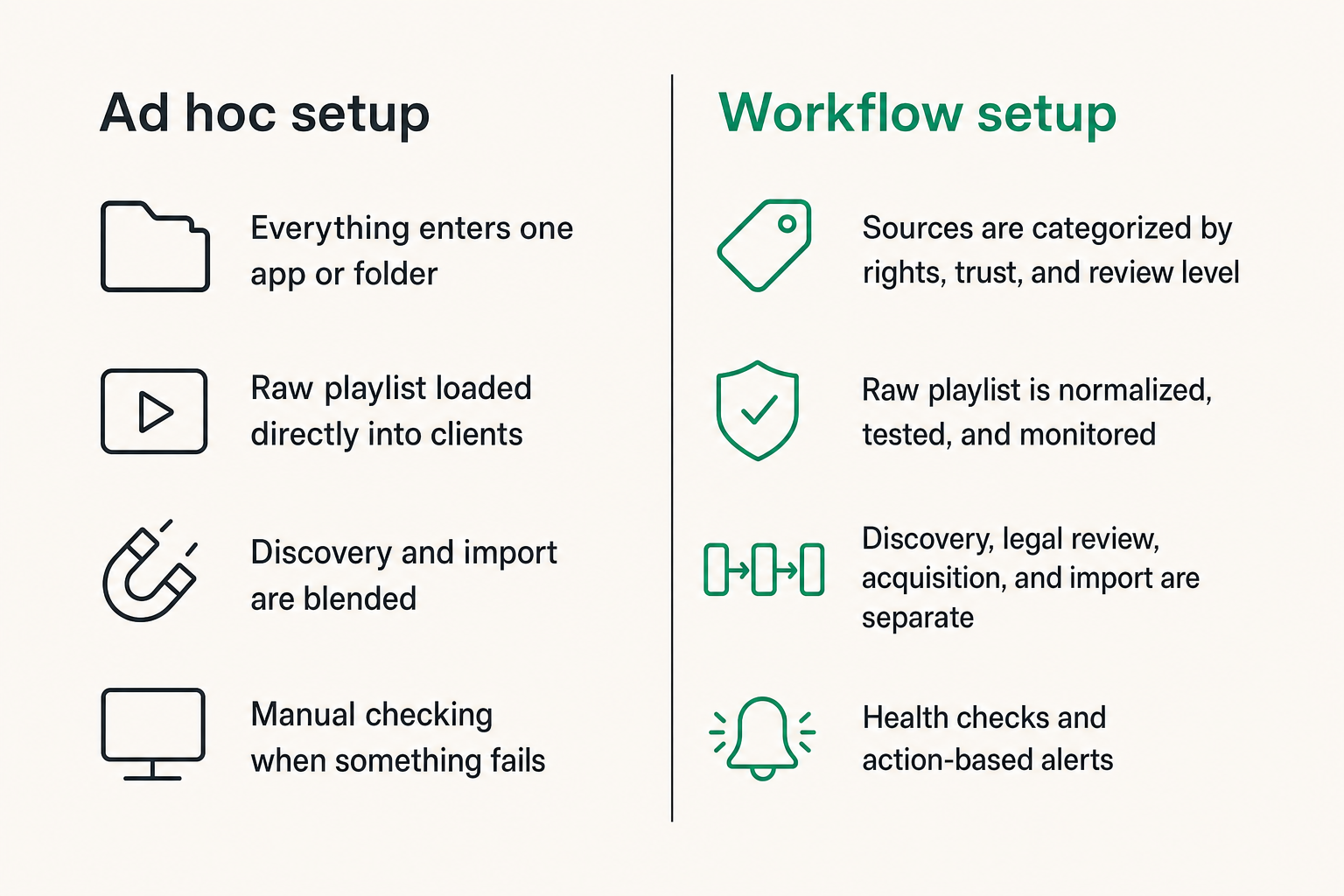
The difference is not that one setup uses expensive tools and the other does not. The difference is whether the workflow has boundaries, state, and feedback.
| Area | Typical consumer setup | Industrialized media workflow |
|---|---|---|
| Source handling | Everything enters one app or folder | Sources are categorized by rights, trust, and review level |
| IPTV | Raw playlist loaded directly into clients | Raw playlist is normalized, tested, and monitored |
| Torrents | Discovery and import are blended | Discovery, legal review, acquisition, and import are separate |
| Storage | One large library path | Hot, warm, cold, cache, quarantine, and archive tiers |
| Networking | VPN on or off globally | Service-level routing with leak prevention |
| Monitoring | Manual checking when something fails | Health checks and action-based alerts |
| Security | Exposed dashboards and broad permissions | Least privilege, local admin paths, documented access |
| Recovery | Reinstall and hope | Backups, rollback paths, and tested restore steps |
What changes in daily operation
The biggest change is not complexity. It is less guessing.
When playback fails, you can tell whether the player, server, network, or source is likely at fault. When an import fails, you know whether it is metadata, permissions, or safety policy. When an IPTV channel disappears, you can compare raw provider data with your normalized playlist.
This also makes the system easier for non-technical users. A family member does not need to know how the stack works. They just need fewer broken buttons. Good architecture hides complexity by making failure paths predictable.
The mistake teams make is thinking operator discipline will make the hobby less fun. In practice, it removes repetitive cleanup and emergency debugging. You spend less time fixing the same problem and more time using the system.
Where bittorrented.com fits
Use it as a discovery and playback layer
bittorrented.com is useful when you treat it as a layer in the workflow, not as the entire workflow. It helps readers who want practical, up-to-date guidance on streaming services, torrents, IPTV, and home media tools, with a bias toward legal, safe, and privacy-aware use.
For a home media operator, a web layer can support several jobs:
- Explore media and streaming workflows before wiring them into your local stack.
- Test how IPTV concepts behave outside your main server.
- Learn safer torrent and DHT habits without collapsing discovery into trust.
- Keep up with practical changes in streaming, IPTV, and home media tooling.
If you want a broader front door for that kind of exploration, BitTorrented is built around streaming services, torrents, IPTV, and home media topics without pretending that one interface replaces good architecture.
Keep ownership of your local stack
A healthy product fit does not ask you to give up your local system. Your NAS, media server, accounts, backups, and network policies remain yours. The web layer should help you discover, test, compare, and learn. It should not become an unreviewed automation root for everything you own.
That is the right architecture boundary. Use hosted tools for visibility and convenience. Use local controls for storage, credentials, private media, and household access. Keep legal decisions and source approval explicit.
This is the same applied industrial technologies mindset again: define the handoff, preserve state, and avoid hidden coupling.
Closing checklist for 2026
What works
If you are rebuilding a torrent, IPTV, or home media workflow in 2026, keep the checklist simple:
- Map source to screen before buying more tools.
- Separate discovery from approval.
- Categorize sources by rights and trust.
- Keep raw IPTV playlists separate from normalized outputs.
- Use storage tiers instead of one giant folder.
- Route network traffic by service, not globally by habit.
- Monitor signals that lead to action.
- Test failure paths before you rely on automation.
- Keep admin interfaces private and permissions narrow.
- Document recovery steps while the system is healthy.
What to avoid
Avoid the patterns that create mystery:
- Blind auto-import from unknown sources.
- Exposed dashboards with weak authentication.
- Privileged containers with full NAS access.
- Cleanup scripts running across mixed folders.
- VPN configurations that fail open silently.
- IPTV playlists with no health checks.
- Metadata automation with no review queue.
- Backups that have never been restored.
The closing point is simple: applied industrial technologies is not about making your home media stack corporate. It is about borrowing the parts of industrial thinking that reduce noise, shorten troubleshooting, improve safety, and keep the system usable when something changes.
Try bittorrented.com
You are writing for readers who want practical, up-to-date guidance on streaming services, torrents, IPTV, and home media tools. Try bittorrented.com