Applied industrial technologies sounds like factory language. For cord cutters, torrent users, IPTV viewers, and home media hobbyists, the pain is much more ordinary: the stream buffers at 9 p.m., the playlist breaks before a match, the NAS fills overnight, or a download finishes but nobody can find the file.
Teams think the problem is the app. The real problem is the workflow around the app.
That changes the conversation. A home media setup is not just a player, a torrent client, an IPTV playlist, and a storage box. It is a small production system with inputs, queues, indexing, failure states, privacy boundaries, retention rules, and support tickets from the rest of the household.
The practical question is not whether applied industrial technologies belong in home media. The practical question is how much industrial thinking you need before your setup stops behaving like a fragile weekend project.
Table of contents
- Applied industrial technologies are a workflow problem
- Map your media stack before you optimize it
- Applied industrial technologies start with state
- Build a legal and privacy-aware acquisition workflow
- Storage is an operations problem, not a shopping list
- Streaming reliability comes from boring controls
- Automation should reduce decisions, not hide problems
- Monitoring makes applied industrial technologies useful at home
- Common failure modes in torrent and IPTV stacks
- Where bittorrented.com fits
Applied industrial technologies are a workflow problem
What the phrase means for media operators
A useful way to think about applied industrial technologies is simple: take the habits used to keep production systems reliable, then apply them to a smaller environment. In home media, that means repeatable workflows, known failure states, clear logs, controlled access, and maintenance routines.
This is not about turning your living room into a factory. It is about recognizing that a modern media setup has industrial-style characteristics. There are multiple sources, multiple consumers, shared infrastructure, automated jobs, remote access paths, and a steady stream of small exceptions.
The mistake teams make is assuming home media is too casual for architecture. Then they add one more IPTV app, one more torrent index, one more drive, one more remote user, and one more script. Six months later nobody knows why playback fails on one device but not another.
Why cord cutters should care in 2026
Cord cutting has become less about canceling one cable bill and more about operating a mixed media environment. A household may use paid streaming services, free legal live channels, public-domain torrents, personal media rips where allowed, IPTV playlists, cloud storage, local NAS storage, and mobile playback.
Each layer has its own limits. Streaming services have account rules and device caps. IPTV sources vary in reliability and legality. Torrenting requires source judgment and privacy controls. Media servers need transcoding headroom. Storage needs lifecycle management.
The practical question is: can your workflow absorb normal failure without turning every issue into manual troubleshooting?
The legal and safety boundary
Applied industrial technologies should not be used to make unsafe or unauthorized access easier. They should help you stay organized around legal sources, licensed content, public-domain media, personal backups where permitted, and privacy-aware networking.
For adjacent privacy thinking, teams in secure communication face similar tradeoffs around metadata, devices, and retention. Related reading from our network: secure messaging architecture in 2026.
Practical rule: If you cannot explain where a media source comes from, whether you are allowed to use it, and what data your client exposes, do not automate it.
Map your media stack before you optimize it
List every input and output
Before buying hardware or installing another app, map the system you already run. Most home media failures are not caused by a single bad component. They come from unclear handoffs between components.
Start with inputs:
- Paid streaming apps
- Legal IPTV playlists and free ad-supported channels
- Public-domain or authorized torrent sources
- Personal media libraries
- Cloud folders
- Remote shares
- Metadata providers
Then map outputs:
- Living room TV
- Mobile devices
- Web players
- Smart TV apps
- Offline downloads
- Family profiles
- Guest access
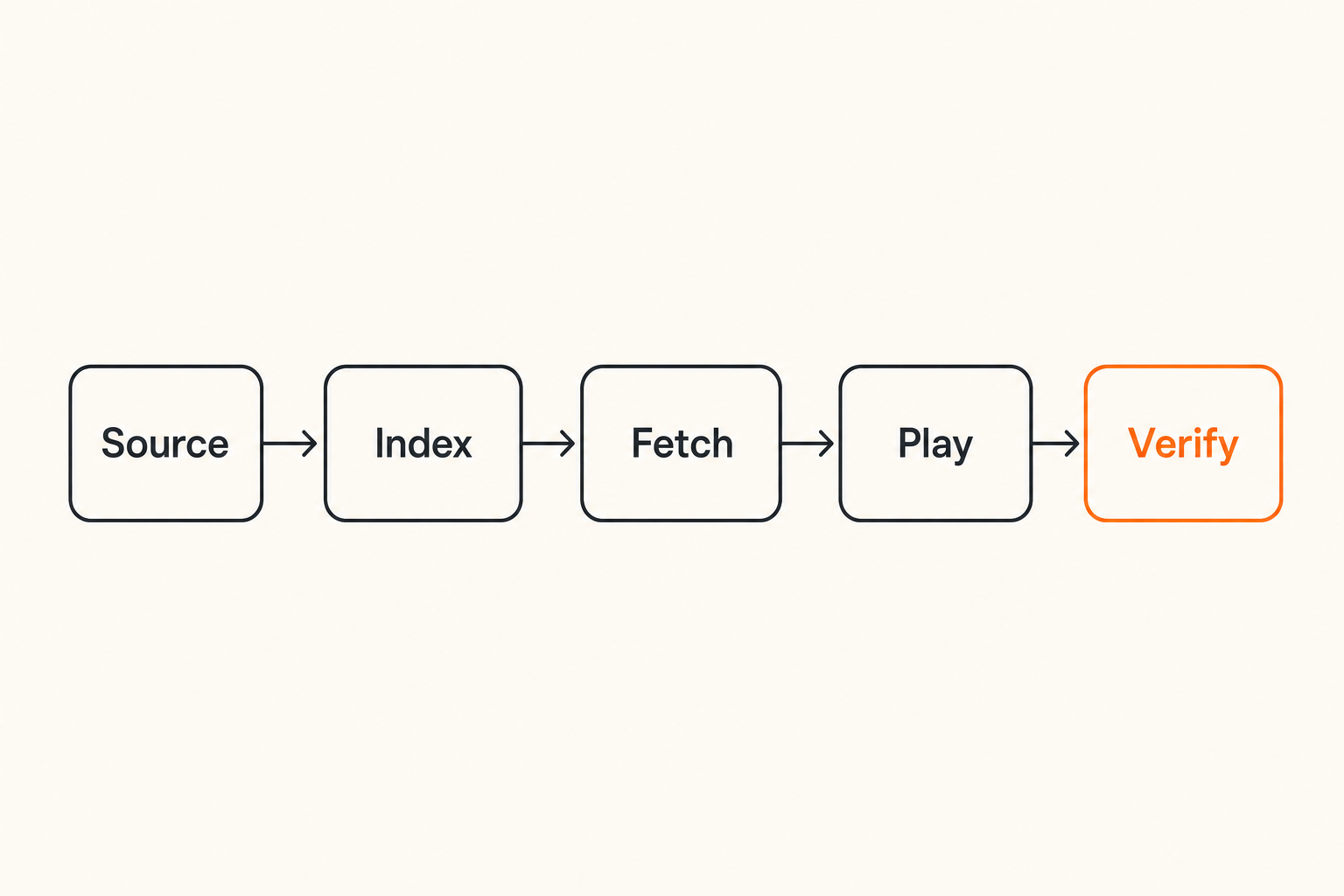
If you use live playlists, keep the playback path separate from the source management path. For example, a viewer may browse channels through a player, while the operator maintains the source list, categories, and uptime checks elsewhere. If you want a practical example of a live viewing surface, the BitTorrented live TV page is relevant because the operational concern is not just channel display; it is how playlists become usable sessions.
Separate playback from acquisition
Playback is the user experience. Acquisition is the supply chain. Mixing them creates confusion.
A torrent client completing a legal download is not the same thing as the media being ready to watch. The file may need verification, naming, metadata lookup, subtitle handling, library scanning, and device compatibility checks. IPTV has a similar split: obtaining a playlist is different from validating channels and presenting them cleanly.
The comparison looks like this:
| Area | Ad hoc setup | Industrial-style home media workflow |
|---|---|---|
| Source intake | Paste links into apps | Maintain approved source lists |
| Download handling | Manual folders | Completed, verified, and sorted states |
| IPTV updates | Replace playlist when broken | Version playlists and validate channels |
| Playback issues | Guess from the couch | Check logs, bandwidth, and device format |
| Privacy | Assume the VPN works | Monitor route, DNS, and client behavior |
| Storage | Buy another drive | Track capacity, retention, and backups |
That changes the conversation. You stop asking which app is best and start asking which workflow is observable.
Document the human handoffs
Many home media systems fail because only one person understands them. That person becomes the support desk.
Write down the basic handoffs:
- Where new legal media enters
- Which folder means pending, ready, failed, or archive
- Which devices are supported
- How to restart services safely
- How to confirm privacy controls are active
- Who can add sources or playlists
This does not need to be a corporate runbook. A one-page note is enough if it prevents random changes during an outage.
Applied industrial technologies start with state
Why state matters more than the interface
Applied industrial technologies become useful when you stop treating media as files and start treating it as state. A file can exist but still be unusable. A channel can appear but still fail. A library can scan but still show the wrong title.
Useful states include:
- Requested
- Approved
- Fetching
- Downloaded
- Verified
- Renamed
- Indexed
- Ready
- Failed
- Archived
What breaks in practice is the gap between downloaded and ready. People assume completion means usability. Then playback fails because the codec is unsupported, the file is incomplete, the metadata is wrong, or the item was stored on a slow disk.
Use queues instead of hope
A queue is just a controlled waiting room. It tells you what is pending, what is running, what failed, and what needs human review.
For home media, queues can be simple:
- A pending folder for new authorized media
- A processing folder for files being renamed or scanned
- A ready folder for stable playback
- A failed folder for items needing review
For torrents, this is especially useful when dealing with legal public-domain archives or open licensed media. Discovery and transport are separate from organization. If you browse distributed sources, a DHT-oriented view such as BitTorrented DHT torrents should still feed into a workflow that checks legality, quality, privacy, and storage before anything becomes part of the household library.
Practical rule: Never let a client completion event be the final authority. Completion means the transport ended. It does not mean the media is approved, safe, indexed, or playable.
Design for retries and reversals
Industrial systems assume failure. Home media setups often assume a clean path.
Build simple retry rules:
- If metadata lookup fails, retry later before manual edit
- If a channel is down, mark degraded before deleting it
- If a file fails verification, move it to failed instead of leaving it mixed with ready media
- If transcoding fails, preserve the original and log the device that triggered it
Also design reversals. If an automation renames files incorrectly, can you restore the previous path? If a playlist update removes working channels, can you roll back? If a storage migration breaks library links, do you have a snapshot?
Build a legal and privacy-aware acquisition workflow
Treat torrents as a transport layer
Torrents are not a content category. They are a transport mechanism. That distinction matters.
A torrent can distribute Linux ISOs, public-domain films, open educational archives, game patches, indie media, or unauthorized copyrighted material. The protocol does not answer the legal question for you. The operator does.
The mistake teams make is automating around availability instead of authorization. Just because something can be fetched does not mean it should be fetched. An industrial-style workflow adds an approval point before acquisition, not after the media is already in the library.
A practical source checklist:
- Is the media public domain, open licensed, owned by you, or otherwise authorized?
- Is the source reputable?
- Does the file naming match the expected item?
- Are comments or hashes available to detect obvious mismatch?
- Does the client expose only the network behavior you expect?
- Is the destination folder outside your ready library until reviewed?
Know what your IPTV source actually is
IPTV is also a delivery method, not a guarantee of legitimacy. Some playlists are official, free, and legal. Some are paid and licensed. Some are gray or plainly unauthorized.
Your workflow should track source type. A simple category model helps:
| IPTV source type | Operational risk | Practical handling |
|---|---|---|
| Official free channel | Low | Monitor uptime and guide data |
| Paid licensed provider | Medium | Track account limits and support path |
| Community playlist | Variable | Validate channels and remove questionable entries |
| Unknown reseller | High | Avoid unless rights and provider identity are clear |
What works is a small approved list that you maintain. What fails is dumping huge playlists into a player and hoping the bad entries do not create problems.
Keep privacy controls observable
Privacy is not a sticker on a VPN app. It is a control you can verify.
For torrent workflows, confirm routing, DNS behavior, kill switch behavior, and client binding. For IPTV and streaming, understand what account, device, IP address, and app telemetry may be involved. For remote access, avoid exposing admin panels directly to the public internet.
Budgeting teams face a surprisingly similar workflow issue: the tool matters, but approvals, integrations, and review cycles matter more. Related reading from our network: budgeting software workflow selection.
Practical rule: A privacy control that nobody checks is a belief, not a control.
Storage is an operations problem, not a shopping list
Capacity planning beats emergency deletion
Storage conversations usually start with drive size. That is backwards. Start with growth rate and deletion rules.
Ask:
- How much new legal media enters each month?
- What percentage is watched once and never again?
- Which items are hard to replace?
- Which items can be re-fetched from legitimate sources?
- How much free space do services need to operate safely?
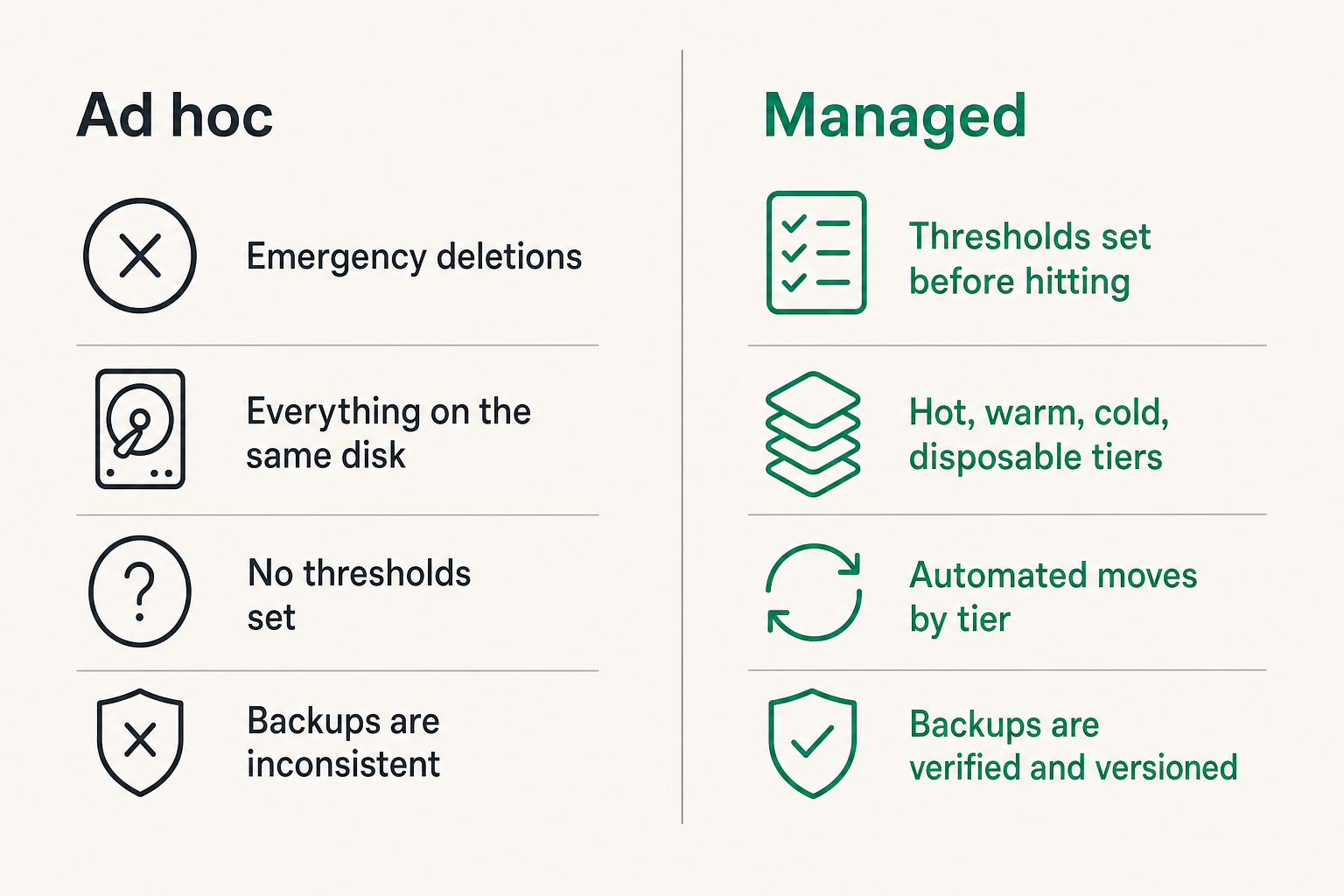
Set thresholds before you hit them. For example:
- At 80 percent full, stop low-priority acquisitions
- At 85 percent full, move cold media to archive storage
- At 90 percent full, disable automated intake until reviewed
This is boring, which is why it works.
Use tiers for hot and cold media
Not every file deserves the same storage. Hot media is actively watched and should live on fast, reliable storage. Cold media can sit on slower disks or offline backup.
A useful tiering model:
- Hot: current shows, frequent movies, live TV buffers, active transcodes
- Warm: watched sometimes, still indexed, available without manual restore
- Cold: archive, backup, rare media, legal collections kept for preservation
- Disposable: cached files, temporary transcodes, failed downloads, stale previews
The biggest win is not saving money. It is reducing the number of files competing for the same disk, scan, and backup resources.
Backups should match replacement pain
Back up what is painful to recreate. That may include configuration more than media.
High-value backup targets:
- Media server database
- Watch history and user profiles
- Playlist versions
- Automation rules
- Custom metadata and artwork
- VPN and network configuration notes
- Scripts and service files
If your media is legally replaceable but your configuration took months to tune, protect the configuration first. Many teams do the opposite. They mirror huge media folders and forget the 40-line config file that makes the system usable.
Streaming reliability comes from boring controls
Buffering is usually a pipeline symptom
Buffering feels like a player issue because the player is where you see it. In practice, it can come from any part of the pipeline:
- Weak Wi-Fi
- Saturated upload
- Slow disk reads
- Heavy transcoding
- Bad IPTV source
- Overloaded VPN endpoint
- DNS delays
- Client format mismatch
The useful move is to isolate the path. Test local playback. Test wired playback. Test direct file access. Test another device. Test the same IPTV channel later. Do not change five variables at once.
Normalize formats before the couch test
The couch is a bad testing environment. By the time someone presses play, the media should already be compatible with the expected devices.
For files, standardize containers, codecs, subtitles, and audio tracks where legal and practical. For IPTV, normalize channel names, groups, logos, and guide references. For streaming services, keep device firmware and app versions current enough to avoid known playback issues.
If your household uses older smart TVs, format policy matters more than raw server power. A small amount of preprocessing can prevent constant live transcoding.
Prefer predictable limits over maximum speed
Home operators often tune for maximum download speed. Then everything else suffers.
Predictability is better:
- Limit torrent bandwidth during viewing hours
- Schedule heavy scans overnight
- Avoid full-disk parity checks during live events
- Reserve CPU headroom for transcoding
- Keep IPTV validation jobs away from prime time
Practical rule: If a background job can ruin playback, it needs a schedule, a limit, or both.
Automation should reduce decisions, not hide problems
What works in home media automation
Good automation removes repetitive decisions while preserving visibility.
What works:
- Rename files according to a known pattern
- Move verified items into ready libraries
- Refresh metadata on a schedule
- Validate IPTV playlist syntax
- Notify when storage crosses thresholds
- Pause nonessential jobs during viewing windows
- Rotate logs before they fill disks
The operator should still be able to answer: what happened, when did it happen, and what changed?
What fails when automation gets vague
Bad automation hides the state of the system. It silently deletes, renames, moves, converts, or fetches without enough context.
Common failures:
- Scripts that assume every file is authorized and correct
- Playlist importers that accept every channel from unknown sources
- Cleanup jobs that delete rare files based only on age
- Transcoding rules that overwrite originals
- Remote request tools with no approval boundary
- Notifications that are too noisy to read
The mistake teams make is confusing fewer clicks with better operations. Sometimes fewer clicks just means faster mistakes.
A practical implementation sequence
Use this sequence if your stack is messy and you want to stabilize it without rebuilding everything at once:
- Freeze major changes for one week. Observe failures instead of adding tools.
- Draw the current source-to-playback path for torrents, IPTV, streaming apps, and local files.
- Create clear states: pending, processing, ready, failed, archive.
- Move all automated intake into pending or processing, never directly into ready.
- Add storage thresholds and disable low-priority jobs when limits are crossed.
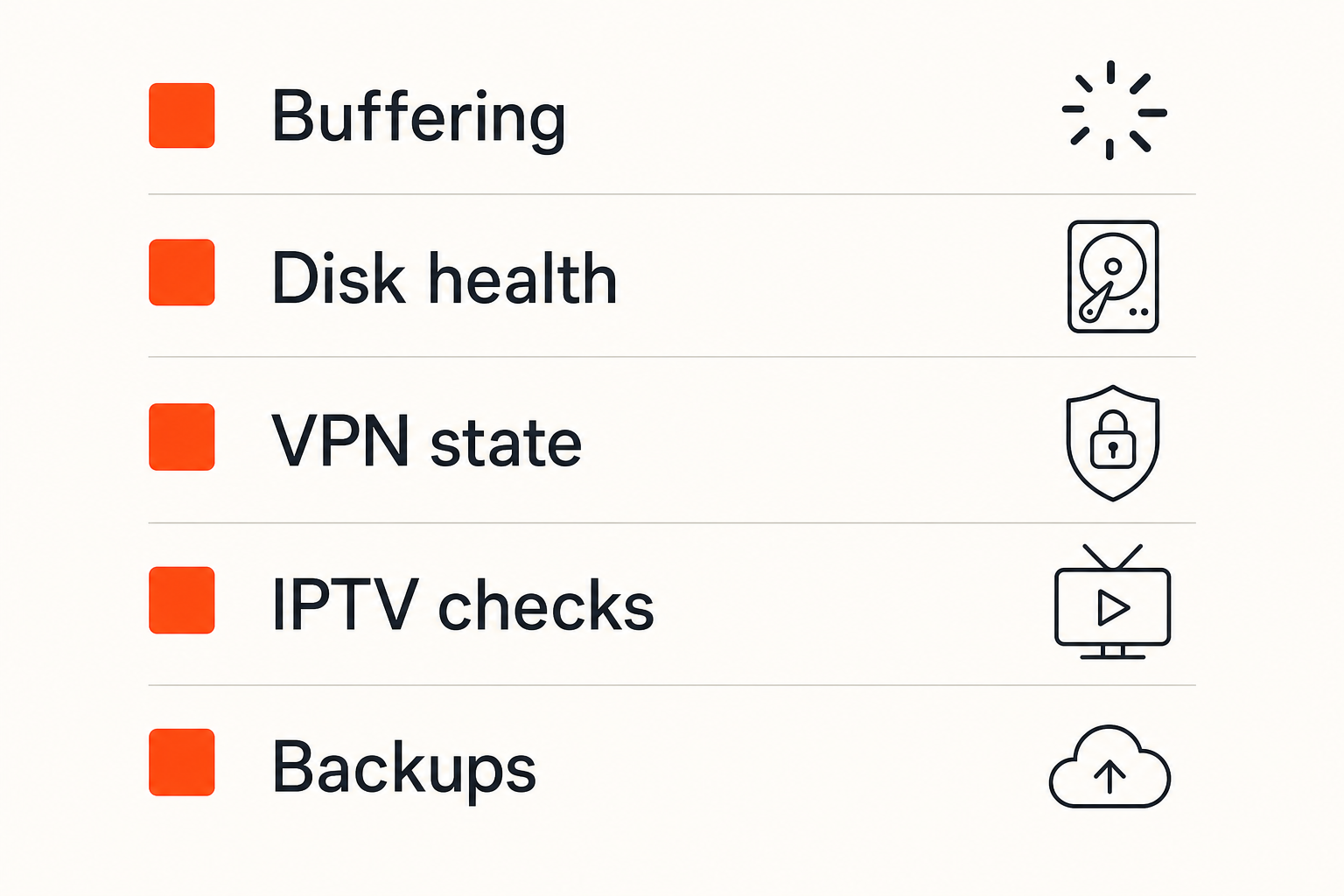
- Add basic monitoring for disk, CPU, network, VPN state, and playback errors.
- Version critical configuration files and playlist sources.
- Test one rollback: restore a playlist, config, or library database from backup.
- Only then add new automation.
A launch workflow has the same lesson in another domain: fragile systems break when checkout, delivery, support, and ownership are glued together at the last minute. Related reading from our network: selling digital products without a fragile launch machine.
Monitoring makes applied industrial technologies useful at home
Track signals that explain user pain
Monitoring does not need to be enterprise-grade. It needs to explain what users feel.
Useful signals include:
- Playback failures by device
- Buffering events by time of day
- Server CPU and GPU load
- Disk latency and free space
- Network throughput during viewing windows
- VPN connected state and public IP checks
- IPTV channel validation results
- Library scan duration
- Failed metadata matches
If a signal does not help explain pain or prevent damage, it is optional.
Alert on degraded service, not every warning
Home media alerting fails when it becomes noise. If every container restart sends a message, people ignore alerts.
Alert on conditions that require action:
- Ready library unavailable
- Storage above emergency threshold
- VPN down while torrent client is active
- IPTV source validation fails for important channels
- Media server cannot transcode expected format
- Backup has not completed in the expected window
Warnings can go to a dashboard or log. Alerts should mean something needs a decision.
Review incidents like an operator
When playback fails, write down the cause after you fix it. Not a long report. Just enough to avoid repeating the same debugging session.
Use a small incident note:
- Date and time
- Symptom
- Affected device or user
- Root cause if known
- Fix applied
- Prevention step
Over time, patterns become obvious. Maybe buffering always happens during scheduled downloads. Maybe one TV cannot handle a codec. Maybe the IPTV playlist breaks every time the provider changes categories. This is where applied industrial technologies earn their keep: repeated pain becomes an engineering input instead of folklore.
Common failure modes in torrent and IPTV stacks
Failure mode one disconnected tools
The most common failure mode is disconnected tooling. A torrent client, IPTV player, media server, metadata tool, VPN app, and NAS dashboard all know part of the truth. None of them knows the whole workflow.
Symptoms:
- Files exist but do not appear in the library
- Channels exist but fail in the player
- Downloads complete but storage fills unexpectedly
- VPN status is unclear
- Users report issues the operator cannot reproduce
The fix is not always one platform. The fix is shared state and clear boundaries. Decide which tool owns intake, which owns playback, which owns storage, and which owns monitoring.
Failure mode two unclear ownership
In a household, ownership sounds excessive until something breaks. Then everybody assumes somebody else changed something.
Set lightweight ownership:
- One person approves new sources
- One person maintains playlists
- One person owns router and VPN changes
- Everyone knows how to report playback issues
- Nobody edits core folders manually during an incident
This is not bureaucracy. It is damage control.
Failure mode three silent policy drift
Policy drift happens when the system slowly stops matching the rules you thought you had.
Examples:
- A pending folder becomes a ready folder because automation was changed
- An old IPTV playlist remains active after you switched providers
- A torrent client update resets network binding
- A media server exposes remote access after a router change
- A cleanup job starts deleting files you intended to archive
The defense is periodic review. Once a month, check sources, routes, storage thresholds, exposed services, and backup restores. If that sounds excessive, compare it with losing a weekend to a preventable outage.
For a deeper adjacent breakdown of this same topic in home media architecture, the prior BitTorrented guide on applied industrial technologies for home media is useful context.
Where bittorrented.com fits
Product fit without pretending the tool fixes everything
A tool can help with discovery, browsing, and access. It cannot replace judgment about legality, privacy, storage policy, or household operations.
The useful product fit for bittorrented.com is at the media workflow layer: helping readers navigate streaming services, torrents, IPTV, and home media tools with a practical bias. That matters because most failures are not definition problems. They are architecture problems.
If you are building a 2026 media setup, use bittorrented.com as part of the research and workflow loop:
- Compare how different media paths behave
- Keep IPTV and torrent discussions grounded in legal, safe use
- Think about privacy before automating acquisition
- Treat playback quality as an operational outcome
- Avoid disconnected tools that hide failure states
Applied industrial technologies do not make a home media stack fancy. They make it less surprising. That is the goal.
Try bittorrented.com
You are writing for readers who want practical, up-to-date guidance on streaming services, torrents, IPTV, and home media tools. For more applied industrial technologies thinking around safe, legal, and privacy-aware media workflows, Try bittorrented.com.